Azerbaijan is physically separated into two parts. To get to the other part from where I live, you must take a bus through Iran or through Georgia. It takes many hours and I obviously can't go through Iran. So when I went last week, I flew. It took 40 minutes.
I went with a Peace Corps friend and her Azerbaijani husband, Ferid. An interesting thing happened. Before we left, a young woman told Ferid that her brother was in the army in the part of the country we were going to. She asked if he would bring her brother some home-cooked food. Ferid barely knew this girl. But he told her he would, got information about his location and when we got to the other part of the country, he told his mother about the situation.
The next morning she got up early and cooked for several hours, making him a large packet of food. Ferid then went to the base, met with the young man and gave him the food. He was gone about 5 hours.
This is perfectly normal in Azerbaijan--spend hours making food for a stranger and delivering it.
--------------------------------------------
Some of the things that are part of everyday life in America didn’t exist when I left the country in 2008. So this time I will ask questions about these things.
For example, Twitter—I have heard of it, but we don’t have it here. It seems like if it did, I could get tweeted (I think that is the term) by Ashton Kutcher or Britney Spears about what they are doing or thinking. Why do people want that? It seems like a lot of people use it. What useful things can a person do with Twitter?
Lady Gaga—I haven’t heard her sing—it is not possible to download from Itunes here. Is she any good? Her outfits are interesting.
The Tea Party---I don’t get them. They seem like a contradiction. They don’t want much Federal government, but they are angry at Obama about not doing something about BP. But according to them, isn’t the government supposed to stay out of regulating stuff?
Most of the Tea Party people seem to be from conservative states like Mississippi, Alabama and Arizona. Maybe they don't know that when Mississippi sends $1.00 to the Federal government in taxes, they get $2.02 back. The balance comes from the liberal states they make fun of, like Massachusetts, which gets 82 cents back for every dollar it sends.
And on the personal responsibility part of the Tea Party—Arkansas, where the Tea Party is strong, has a divorce rate almost twice the rate of Massachusetts. The same for SAT scores, teen pregnancy, school drop-out rates and incarceration rates—the Tea Party states seem to have a problem with personal responsibility as well as for paying their own way. So why don’t they like the Federal government?
The Real Housewives—who are they? Are they really "real"? Are they actresses? Is this a reality show or a drama?
Apple Tablet—I want one, I think. How does the virtual keyboard work? Can I get away without a real computer if I have one of these? Will I miss the optical drive? Is it better to read books on it Kindle-like or is it better to tote the book around?
Thursday, July 1, 2010
Sunday, June 20, 2010
You May Have Closets and Electricity, But I Have Mulberries
I have written about things that annoy or inconvenience me in Azerbaijan—lack of central heating, closets, competent repairpersons, intermittent lack of electricity and water. On the other hand, there are some things that to me are better.
Azerbaijanis don’t see the point of having a tree on their property unless it gives fruit or nuts. So throughout the summer and fall, fruit and nuts are everywhere. Now it is mulberries and apricots and cherries. Later it will be plums, other berries, peaches, figs, pears and apples. Best of all is pomegranate—they are everywhere. In the southern region of Azerbaijan, people have tangerine, orange, lemons and grapefruit.
Although we only have one tree of each, my yard has many more mulberries and cherries than we can eat, so we are canning, giving fruit away and feeding some to the chickens. Azerbaijanis don’t seem to fertilize, use insecticide or prune their fruit trees, but they do just fine. I like the idea of trees producing something instead of just being there.
Another things I admire about Azerbaijan is that there is reliable, frequent public transportation almost everywhere and towns and cities are compact and walkable. Good, cheap public transportation in Azerbaijan, Turkey and Georgia is seen as necessary for the country to be successful. The capital city of Baku has new, clean, frequent buses going everywhere for the equivalent of about 25 cents a ride. They also have a good subway, with new stations being built. Many of the foreigners in Baku and wealthy people don’t want to take public transportation, however, and there are many SUV’s there.
Smaller cities have older buses and vans that are sometimes pretty dilapidated, but they run. People who live in the country can travel on these older buses and vans for work or visits to relatives. Things are more pleasant because people walk and take public transportation instead of having to buy a car. And the poor are not at as much of a disadvantage transportation-wise.
As I meet Europeans and travel around this area, I hear comments and realize how much more violent America is than most other countries. I feel much safer from crime here and even in the capital city of Baku. When my daughter was in Berlin as a 13-year old, I wondered why the teacher allowed her and one other student to wander around by themselves for hours. She explained that Europe is overall much safer than America.
Many Americans feel safe in their own neighborhoods because most of the crime and violence happens in neighborhoods where the poor live. And that is one difference between America and some other countries in which crime is lower—the poor do not live in neighborhoods by themselves. They are able to be dispersed to live with everyone else. The opportunity for poor children to be surrounded by people with jobs, decent schools, a safe environment and city services helps them to become productive citizens and not repeat the cycle.
Which leads me to the final thing I like about Azerbaijan and living in this part of the world. Azerbaijanis don’t think they have all the answers. They think they can get some good ideas from people in other countries. Maybe I am cynical from reading all the bad news that has happened since I left the country in 2008. But I do know that no other country thought going to war in Iraq was a good idea.
We are the only developed country that still executes people and somehow we still have by far the highest murder rate of all—execution doesn’t seem like a deterrent. And our teen pregnancy rate and infant mortality rates are much higher than other developed countries, but we don’t seem very curious about how other countries do so much better than we do. Canada’s banking system is doing just fine—they have good regulation so did not have unsafe mortgage instruments and did not allow the type of financial products that led to our collapse. But we don’t seem to know how they did it or even that they are okay up there.
Now I will go back to eating mulberries.
Azerbaijanis don’t see the point of having a tree on their property unless it gives fruit or nuts. So throughout the summer and fall, fruit and nuts are everywhere. Now it is mulberries and apricots and cherries. Later it will be plums, other berries, peaches, figs, pears and apples. Best of all is pomegranate—they are everywhere. In the southern region of Azerbaijan, people have tangerine, orange, lemons and grapefruit.
Although we only have one tree of each, my yard has many more mulberries and cherries than we can eat, so we are canning, giving fruit away and feeding some to the chickens. Azerbaijanis don’t seem to fertilize, use insecticide or prune their fruit trees, but they do just fine. I like the idea of trees producing something instead of just being there.
Another things I admire about Azerbaijan is that there is reliable, frequent public transportation almost everywhere and towns and cities are compact and walkable. Good, cheap public transportation in Azerbaijan, Turkey and Georgia is seen as necessary for the country to be successful. The capital city of Baku has new, clean, frequent buses going everywhere for the equivalent of about 25 cents a ride. They also have a good subway, with new stations being built. Many of the foreigners in Baku and wealthy people don’t want to take public transportation, however, and there are many SUV’s there.
Smaller cities have older buses and vans that are sometimes pretty dilapidated, but they run. People who live in the country can travel on these older buses and vans for work or visits to relatives. Things are more pleasant because people walk and take public transportation instead of having to buy a car. And the poor are not at as much of a disadvantage transportation-wise.
As I meet Europeans and travel around this area, I hear comments and realize how much more violent America is than most other countries. I feel much safer from crime here and even in the capital city of Baku. When my daughter was in Berlin as a 13-year old, I wondered why the teacher allowed her and one other student to wander around by themselves for hours. She explained that Europe is overall much safer than America.
Many Americans feel safe in their own neighborhoods because most of the crime and violence happens in neighborhoods where the poor live. And that is one difference between America and some other countries in which crime is lower—the poor do not live in neighborhoods by themselves. They are able to be dispersed to live with everyone else. The opportunity for poor children to be surrounded by people with jobs, decent schools, a safe environment and city services helps them to become productive citizens and not repeat the cycle.
Which leads me to the final thing I like about Azerbaijan and living in this part of the world. Azerbaijanis don’t think they have all the answers. They think they can get some good ideas from people in other countries. Maybe I am cynical from reading all the bad news that has happened since I left the country in 2008. But I do know that no other country thought going to war in Iraq was a good idea.
We are the only developed country that still executes people and somehow we still have by far the highest murder rate of all—execution doesn’t seem like a deterrent. And our teen pregnancy rate and infant mortality rates are much higher than other developed countries, but we don’t seem very curious about how other countries do so much better than we do. Canada’s banking system is doing just fine—they have good regulation so did not have unsafe mortgage instruments and did not allow the type of financial products that led to our collapse. But we don’t seem to know how they did it or even that they are okay up there.
Now I will go back to eating mulberries.
Friday, June 11, 2010
Becoming a Prima Donna
These are some things that have happened to me lately:
Last week I had to go to the airport in Baku. It is about a $25 taxi ride, so I took the bus. That involves being dropped off a couple of miles from the airport and hiking along an expressway with no sidewalks.
Since I don’t have much call to go to the airport, I didn’t know how far it was and how difficult the walking would be. I saw no taxis coming or going.
But what did happen is that many, many drivers stopped to offer me a ride. Some backed up on the expressway, others pulled over abruptly. Ninety eight percent of drivers in Azerbaijan are men—so many men traveling alone offered me a ride.
Later, I found out that on this stretch of the road, it is normal to get a ride to and from the bus stop.
I think I have written before about another volunteer who was flying to Europe to meet her parents. Unbeknownst to her, her flight had been rescheduled for two days later. When she arrived and learned the news, she was unsure what to do, since she lives about 6 hours away from the airport. Several airport staff invited her to stay with them for two days.
After I left the airport, I was in the subway. I asked a woman sitting in an information booth which train to take. She was so thrilled that I spoke Azerbaijani (most foreigners working in Baku don’t speak Azerbaijani) that she invited me to her home for tea. She was ready to pack up and leave. I had to tell her that I was in a hurry to get back to my town.
Yesterday I needed to go to a notary. Someone told me where the office was located, but when I got there, I didn’t see the office, so went into a travel agency in the same building and asked. They said the office had moved. The owner of the business told me where they had moved, but insisted on driving me there.
When I got to the office, they did my transaction and when I asked how much it would cost, they told me that since I am a guest in the city, it would be free.
The Peace Corps tells us that most volunteers experience reverse culture shock when they get back to America. I remember that in America I was not a celebrity, but I am not sure I will like this fact!
Last week I had to go to the airport in Baku. It is about a $25 taxi ride, so I took the bus. That involves being dropped off a couple of miles from the airport and hiking along an expressway with no sidewalks.
Since I don’t have much call to go to the airport, I didn’t know how far it was and how difficult the walking would be. I saw no taxis coming or going.
But what did happen is that many, many drivers stopped to offer me a ride. Some backed up on the expressway, others pulled over abruptly. Ninety eight percent of drivers in Azerbaijan are men—so many men traveling alone offered me a ride.
Later, I found out that on this stretch of the road, it is normal to get a ride to and from the bus stop.
I think I have written before about another volunteer who was flying to Europe to meet her parents. Unbeknownst to her, her flight had been rescheduled for two days later. When she arrived and learned the news, she was unsure what to do, since she lives about 6 hours away from the airport. Several airport staff invited her to stay with them for two days.
After I left the airport, I was in the subway. I asked a woman sitting in an information booth which train to take. She was so thrilled that I spoke Azerbaijani (most foreigners working in Baku don’t speak Azerbaijani) that she invited me to her home for tea. She was ready to pack up and leave. I had to tell her that I was in a hurry to get back to my town.
Yesterday I needed to go to a notary. Someone told me where the office was located, but when I got there, I didn’t see the office, so went into a travel agency in the same building and asked. They said the office had moved. The owner of the business told me where they had moved, but insisted on driving me there.
When I got to the office, they did my transaction and when I asked how much it would cost, they told me that since I am a guest in the city, it would be free.
The Peace Corps tells us that most volunteers experience reverse culture shock when they get back to America. I remember that in America I was not a celebrity, but I am not sure I will like this fact!
Tuesday, May 25, 2010
Travel and Carpets
Most volunteers travel out of the country while they are here. We get 22 days travel time each year, and the Peace Corps hopes we will spend most of the travel in the country. This is because when we go back to America, we are supposed to share our experience here with others and speak knowledgeably about Azerbaijan. We are given the equivalent of about $25 per month for travel in the country. Since buses are cheap and many times we can stay with another volunteer, the money is adequate.
Of course, since the country is small--about the size of Maine—we are able to do significant in-country travel over a few days, including weekends. There are numerous holidays throughout the year, so some volunteers travel in Azerbaijan without using vacation time and spend most of their 44 days of travel during their two years of service outside the country.
Most volunteers use some of their vacation time to return to America once for family events such as weddings, funerals or for Christmas. Nearby travel alternatives are somewhat limited—to the south is Iran; to the east, the Caspian Sea; to the north, a part of Russia that is experiencing a lot of civil unrest; and also Georgia, which is interesting and where many volunteers go.
To the west is Armenia, where we can’t go. Azerbaijan is locked in conflict with Armenia, which is occupying part of Azerbaijan. Further to the west is a separate part of Azerbaijan which we can fly to; and west of that is Turkey.
So when my sister recently came to visit, we visited several cities in Azerbaijan; the capital of Georgia, Tbilisi; and Istanbul in Turkey.
One of the things I like about traveling in Azerbaijan is that outside of Baku, the capital, there are few tourists or foreigners. Azerbaijanis welcome tourists and sometimes I even feel like a celebrity traveling around Azerbaijan because tourists are spoiled. It is easy to engage with locals and learn from them. Interesting sites are never crowded and it is possible to see much more than in a roped-off guarded tourist-popular museum in another country. Museums in the regions of Azerbaijan mostly display things outside of glass cases and touching is often allowed. The curation is somewhat haphazard and the information about each piece is often scant or missing, but the overall experience is interesting and charming.
Tourist sites are also different that in more often-visited countries. For example, Azerbaijan is one of the few places in the world with mud volcanoes. They are vast flat plains of dirt with occasional small and large pools of mud in which gases regularly pop to the surface, creating bubbling pools which sometimes throw up a geyser of mud. The mud is cold. Most of the locals don’t realize they are there—they just go about their business in their villages. One you find the volcanoes—nothing is marked on the road--you can walk right up to the edge of an individual volcano, stick your hand in the volcanoes and maybe get hit by a geyser. Nearby are 20,000 year-old cave paintings. There are guided tours in the cave section if you want, but the whole scene is relaxed and there are no barriers.
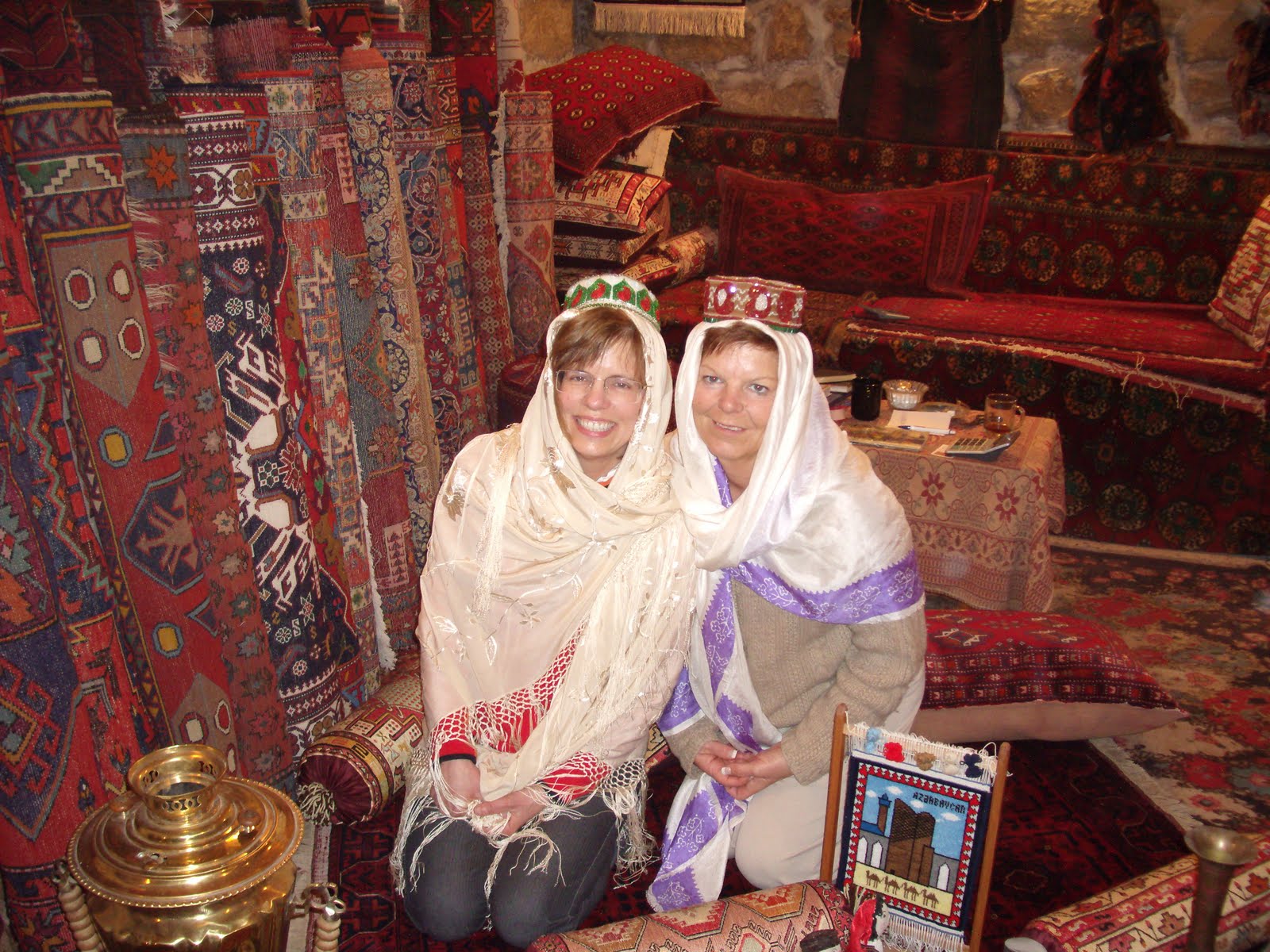
In the few artisan workshops in Azerbaijan, such as a rug weaving workshop, workers will stop and talk about their work or allow us to sit and watch them work. They will explain the different types of designs, how wool is spun from local sheep, is dyed with vegetables, fruits and herbs, how designs are chosen and how rugs are made.
So when my sister came, I knew we wanted to visit certain sites in Azerbaijan. I also took her to Tbilisi, Georgia, where I had been twice before. But this time, I thought I was ready to go to Istanbul with her.
Of course, since the country is small--about the size of Maine—we are able to do significant in-country travel over a few days, including weekends. There are numerous holidays throughout the year, so some volunteers travel in Azerbaijan without using vacation time and spend most of their 44 days of travel during their two years of service outside the country.
Most volunteers use some of their vacation time to return to America once for family events such as weddings, funerals or for Christmas. Nearby travel alternatives are somewhat limited—to the south is Iran; to the east, the Caspian Sea; to the north, a part of Russia that is experiencing a lot of civil unrest; and also Georgia, which is interesting and where many volunteers go.
To the west is Armenia, where we can’t go. Azerbaijan is locked in conflict with Armenia, which is occupying part of Azerbaijan. Further to the west is a separate part of Azerbaijan which we can fly to; and west of that is Turkey.
So when my sister recently came to visit, we visited several cities in Azerbaijan; the capital of Georgia, Tbilisi; and Istanbul in Turkey.
One of the things I like about traveling in Azerbaijan is that outside of Baku, the capital, there are few tourists or foreigners. Azerbaijanis welcome tourists and sometimes I even feel like a celebrity traveling around Azerbaijan because tourists are spoiled. It is easy to engage with locals and learn from them. Interesting sites are never crowded and it is possible to see much more than in a roped-off guarded tourist-popular museum in another country. Museums in the regions of Azerbaijan mostly display things outside of glass cases and touching is often allowed. The curation is somewhat haphazard and the information about each piece is often scant or missing, but the overall experience is interesting and charming.
Tourist sites are also different that in more often-visited countries. For example, Azerbaijan is one of the few places in the world with mud volcanoes. They are vast flat plains of dirt with occasional small and large pools of mud in which gases regularly pop to the surface, creating bubbling pools which sometimes throw up a geyser of mud. The mud is cold. Most of the locals don’t realize they are there—they just go about their business in their villages. One you find the volcanoes—nothing is marked on the road--you can walk right up to the edge of an individual volcano, stick your hand in the volcanoes and maybe get hit by a geyser. Nearby are 20,000 year-old cave paintings. There are guided tours in the cave section if you want, but the whole scene is relaxed and there are no barriers.
In the few artisan workshops in Azerbaijan, such as a rug weaving workshop, workers will stop and talk about their work or allow us to sit and watch them work. They will explain the different types of designs, how wool is spun from local sheep, is dyed with vegetables, fruits and herbs, how designs are chosen and how rugs are made.
So when my sister came, I knew we wanted to visit certain sites in Azerbaijan. I also took her to Tbilisi, Georgia, where I had been twice before. But this time, I thought I was ready to go to Istanbul with her.
Monday, May 17, 2010
Sunday, May 2, 2010
Closets, A Party and Wars
I had a party Sunday. There were 12 guests at a sit-down meal. The party was in honor of the Azerbaijani husband of a Peace Corps Volunteer. The young man just got his visa to go to America with his wife. Guests were split between American volunteers and Azerbaijanis.
The couple met when she arrived as a volunteer, survived his being gone for a year for compulsory military service, and a few months after his return they were married officially in Baku and then had a traditional Azerbaijani wedding in his hometown.
The bride extended her service a year to accommodate all of this and they will go to America in October. The groom is 24 and his wife is 27. He spent one year of high school on an exchange program, living in Florida. His English is excellent, he is a very intelligent, kind and interesting person.
My host family set the table like a wedding, with beautiful china and table decorations. Even poor Azerbaijanis have nice china. In Soviet times, china was priced so that an average family could buy it and apparently, most did. As in America, it is handed down.
I made different salads and side dishes while my family fussed about the lack of Azerbaijani food. They wanted to spend the day cooking but I told them they were guests. Why no Azerbaijani food? Well, when you invite Italians over to dinner, do you cook Italian food? Of course not, because it will not be authentic. Afterward, just when my family was ready to attack the dishes, some of the American guests began washing them. I had warned the family that this was an American tradition for some families, but they were still dismayed to see guests rolling up their sleeves and washing dishes. Our kitchen is outside and the day was unseasonably cold, which made it more interesting.
------------------------------
The primary way that Azerbaijanis receive their news is through the television. Apparently, some American soldiers shot a group of Iraqi civilians, the incident was recorded on tape, including narration by the shooters as they shot, and is on YouTube. The tape is also being played here on the news with questions from my family and a general level of disgust from those who have seen it.
My family keeps asking me if Obama said he would stop the wars, why hasn’t he stopped them? Why is he allowing the murder of innocent children by American troops? Why do people still support him if he is not stopping these things? I always try to stay away from political talk with Azerbaijanis, both about American politics and about Azerbaijani politics. On the Azerbaijani side, obviously Azerbaijan is not my country and it is really none of my business. On the American side, I am not here to discuss American politics. But I don't feel I can ignore persistent and pointed questions.
If Azerbaijanis know several Americans, I usually tell them to ask all Americans they know because they will get different answers. My opinion, I tell is them that presidential power is different in America than it is in Azerbaijan and that Obama can’t do a lot of things by himself without the support of other branches. And also that we are supposed to be mostly out of Iraq later this year. They reply that Bush did what he wanted, why can’t Obama? My next answer is that when Americans are angry, some tend to think of using force for three reasons:
One is that Americans don’t understand what it is like to have a war on their own soil.
Another is that Americans don’t have to fight the wars. Our military is all-volunteer. In Azerbaijan, all males must serve 1-1 1/2 years.
The third is that Americans feel they don’t have to pay for wars. Taxes are not raised when wars are started. In fact, with these two wars, taxes were lowered.
This is one I didn’t say, but thought about: Americans feel they can prevail against terrorists by using force. I was reading something awhile back that said that there was not an instance of a powerful country defeating terrorists in the past 100 years or so. I am not sure if this is true or not, but I can’t think of an instance in which America prevailed over terrorists, probably because they are so much more committed than we are. And of course, in our own version of terrorists, we didn't win against the criminals in the Prohibition area and are not wining the war on drugs.
In Revolutionary War times, if the Brits had beaten us, I doubt we would have given up and happily accepted being part of Britain. I think we would still be fighting them.
So I explain that in my opinion, if Americans are angry, they can invade another country for free and send people they don’t know to fight it. Then they can change their minds about being there when it goes badly and leave without having anything bad happen in their American lives.
---------------------------------------------------
I don’t miss a lot of American material things—a few that I do miss are central heating, having inside bathrooms in houses and nice showers with instant hot water and a good spray . Another amenity I miss is having closets. I thought most people had closets. I have have yet to see a closet in Azerbaijan.
Clothes are kept in chests of drawers, or wardrobes, some with a small closet area. I fold my clothes or hang them on a coat tree. So that they don’t get wrinkeled, I have hangers on the coat tree, which leads to crossed-up hangers and not much room for coats.
Most Azerbaijanis have few clothes, since they are expensive. Wearing the same blouse or shirt for a few days is not unusual. One of the women who lives in my home has one sweater. For the first 15 days I lived here, she wore it every day. That was excessive, in my opinion. Then she washed it and wore a robe for two days while it dried.
The couple met when she arrived as a volunteer, survived his being gone for a year for compulsory military service, and a few months after his return they were married officially in Baku and then had a traditional Azerbaijani wedding in his hometown.
The bride extended her service a year to accommodate all of this and they will go to America in October. The groom is 24 and his wife is 27. He spent one year of high school on an exchange program, living in Florida. His English is excellent, he is a very intelligent, kind and interesting person.
My host family set the table like a wedding, with beautiful china and table decorations. Even poor Azerbaijanis have nice china. In Soviet times, china was priced so that an average family could buy it and apparently, most did. As in America, it is handed down.
I made different salads and side dishes while my family fussed about the lack of Azerbaijani food. They wanted to spend the day cooking but I told them they were guests. Why no Azerbaijani food? Well, when you invite Italians over to dinner, do you cook Italian food? Of course not, because it will not be authentic. Afterward, just when my family was ready to attack the dishes, some of the American guests began washing them. I had warned the family that this was an American tradition for some families, but they were still dismayed to see guests rolling up their sleeves and washing dishes. Our kitchen is outside and the day was unseasonably cold, which made it more interesting.
------------------------------
The primary way that Azerbaijanis receive their news is through the television. Apparently, some American soldiers shot a group of Iraqi civilians, the incident was recorded on tape, including narration by the shooters as they shot, and is on YouTube. The tape is also being played here on the news with questions from my family and a general level of disgust from those who have seen it.
My family keeps asking me if Obama said he would stop the wars, why hasn’t he stopped them? Why is he allowing the murder of innocent children by American troops? Why do people still support him if he is not stopping these things? I always try to stay away from political talk with Azerbaijanis, both about American politics and about Azerbaijani politics. On the Azerbaijani side, obviously Azerbaijan is not my country and it is really none of my business. On the American side, I am not here to discuss American politics. But I don't feel I can ignore persistent and pointed questions.
If Azerbaijanis know several Americans, I usually tell them to ask all Americans they know because they will get different answers. My opinion, I tell is them that presidential power is different in America than it is in Azerbaijan and that Obama can’t do a lot of things by himself without the support of other branches. And also that we are supposed to be mostly out of Iraq later this year. They reply that Bush did what he wanted, why can’t Obama? My next answer is that when Americans are angry, some tend to think of using force for three reasons:
One is that Americans don’t understand what it is like to have a war on their own soil.
Another is that Americans don’t have to fight the wars. Our military is all-volunteer. In Azerbaijan, all males must serve 1-1 1/2 years.
The third is that Americans feel they don’t have to pay for wars. Taxes are not raised when wars are started. In fact, with these two wars, taxes were lowered.
This is one I didn’t say, but thought about: Americans feel they can prevail against terrorists by using force. I was reading something awhile back that said that there was not an instance of a powerful country defeating terrorists in the past 100 years or so. I am not sure if this is true or not, but I can’t think of an instance in which America prevailed over terrorists, probably because they are so much more committed than we are. And of course, in our own version of terrorists, we didn't win against the criminals in the Prohibition area and are not wining the war on drugs.
In Revolutionary War times, if the Brits had beaten us, I doubt we would have given up and happily accepted being part of Britain. I think we would still be fighting them.
So I explain that in my opinion, if Americans are angry, they can invade another country for free and send people they don’t know to fight it. Then they can change their minds about being there when it goes badly and leave without having anything bad happen in their American lives.
---------------------------------------------------
I don’t miss a lot of American material things—a few that I do miss are central heating, having inside bathrooms in houses and nice showers with instant hot water and a good spray . Another amenity I miss is having closets. I thought most people had closets. I have have yet to see a closet in Azerbaijan.
Clothes are kept in chests of drawers, or wardrobes, some with a small closet area. I fold my clothes or hang them on a coat tree. So that they don’t get wrinkeled, I have hangers on the coat tree, which leads to crossed-up hangers and not much room for coats.
Most Azerbaijanis have few clothes, since they are expensive. Wearing the same blouse or shirt for a few days is not unusual. One of the women who lives in my home has one sweater. For the first 15 days I lived here, she wore it every day. That was excessive, in my opinion. Then she washed it and wore a robe for two days while it dried.
Thursday, April 22, 2010
Starfish II
A post in December called Starfish (http://lindazb.blogspot.com/search?q=starfish&updated-max=2009-12-03T01%3A24%3A00-08%3A00&max-results=20) was about a dog who lived outside my house. She was not a typical street dog, feral and street-smart. Because of the way she acted, people think she has lived with a family sometime in her life. But when I met her last September, she lived outside my home because my host mother fed her every day. When I say “outside our home” I mean on the street. Most Azerbaijani homes are accessed through a gate door. When you enter, there is the yard and the house. So the home and yard are enclosed behind walls. Outside on the street, when it rained, she got wet, and she slept in the mud. She did not hide or go off to remote areas with the other dogs. We think this is because she did not know how to live on her own with other feral dogs. As winter advanced, she slept on the cold and frozen ground outside our door.
In January, she gave birth to 5 puppies and it was difficult for her to sustain them in the cold weather. But the neighbors helped by making a shelter for her in the street and giving her extra food. Of course, the food consisted of whatever food they had that was too old or spoiled to eat, such as old bread, rice and potatoes.
The pups left for who-knows-where, but she remained. Every day for 7 months she came up to me, her tail wagging. I didn’t feed her, as I hoped she would learn how to find her own food like other dogs. They root through garbage bins. But she still greeted me with excitement and a wag every day. She is only about 20 pounds and skinny.
We couldn’t take her in because the family already had a dog and the grandma had moved in and didn’t like the existing dog much. Dogs in the home (even though they live in the yard) are rare in Azerbaijan.
I grew increasingly concerned about this dog and was worried about her getting pregnant again. I saw her eating dirt several times. I decided to take her to the vet in our town. It was difficut because I didn’t know how to get her there. I got a leash and practiced with her for several days, giving her food as a reward. My neighbors stared. No one walks dogs on leashes here, plus I was squatting on the ground talking to a street dog.. I told a neighborhood taxi driver what I was trying to do. He agreed to transport us to the vet. I ended up lifting her into the taxi. She was frightened at first, but got used to the ride. At the vet, she got an immunization. He said she was basically healthy, but was eating dirt because the food she was getting did not have enough nutrition.
At this point, one of our volunteers had to leave because of health issues. Her host family was open to considering having a dog live in their yard. This and the lack of food for me at my home induced me to move there.
One of my fellow volunteers works at the national agriculture university, which is located in my city. She inquired there to see if anyone could spay dogs (the veterinarian I had taken her to for the vaccination doesn’t do this operation). She found that the head of the veterinary department is able to spay dogs. I had the dog come to the new house (using the same taxi routine, scooping her off the street) as a guest and she met my new family. They looked at her dubiously from afar and I soon returned her to the street. Nothing was said until a few days later when it was raining and I remarked that I was thinking about how wet the dog was on the street. They said we could try having her at home.
I didn’t want her kicked out before she was spayed, so the day before the operation, I scooped her off the street for the third time and brought her here. She had the operation over the weekend, and seems to be recovering okay. She lives in a sturdy dog house made out of some junk in the yard. She has eaten some peanut butter, hard boiled eggs and a little dog food. The vet said to give her soup and sweet tea after the operation, but she didn’t want it.
The reaction to the spaying by Azerbaijanis has been interesting. They are pretty horrified by the operation. When I bring up the standard argument that we use in America about limiting the number of homeless dogs and unwanted puppies, people just say that dogs deserve the chance to live. They say that many can find food, that nature wants dogs to be parents and that we should not interefere with that. The owner-pet bond that we value so much in the United States is not well-known here, and Azerbaijanis feel that dogs living on the street are not necessarily unhappy and may in fact, be happy.
While I understand this opinion and have come to accept it, I still think there should be some help for street dogs and cats who are ill and some form of population control other than starvation or sickness. I also think that while the suffering of homeless dogs and cats here there for all to see, we tend to hide our poor treatment of animals.. Chickens who never leave cages, pigs and calves raised in factories in which they can’t even turn around, universities with painful and often unnecessary experimentation on dogs and in my state of Missouri, horrible conditions in puppy mills and a law that does not even allow photos to be taken to document the bad conditions.
In Azerbaijan, many farm animals lead idyllic lives, with large pastures and chickens live outside and can wander about. Azerbaijani farmers feel no need to give the antibiotics and other medications to animals because they normally don’t live in close quarters on factory farms. Azerbaijanis probably eat more mutton and lamb than other meats. Many sheep spend their lives moving from meadow to meadow, going up mountains in the summer to stay cool.
The other thing that interested me about the reaction to spaying is that abortion is the primary method of contraception in Azerbaijan. When I asked why abortion is considered fine and accepted for humans, but spaying and neutering is not acceptable for animals, I got the answer that there is not enough money for large families since the fall of the Soviet Union and there is no choice. Dogs on the street don’t cost anything to raise, but children do. When I asked why humans can’t have operations to prevent pregnancy instead of abortions, the people I asked said that operations were considered dangerous and upsetting, but that abortions are considered safe and common.
Anyway, when I brought the dog home after the operation, my family was upset that I had gone through with it. While I checked on her in her new doghouse, my family, who had wrinkled their noses when I brought her home, tiptoed around to see how she was doing and asked me if she had accepted any food or drink. When she hadn’t after several hours, they began giving me suggestions of what might tempt her and began loudly praying to Allah for her speedy recovery. They were overjoyed when she began eating and drinking.
Now that I have the dog with me, I hope that she doesn’t get kicked out of this house and can spend the summer enjoying not being homeless anymore. But in the fall, I will need to find a home in America for her.
In January, she gave birth to 5 puppies and it was difficult for her to sustain them in the cold weather. But the neighbors helped by making a shelter for her in the street and giving her extra food. Of course, the food consisted of whatever food they had that was too old or spoiled to eat, such as old bread, rice and potatoes.
The pups left for who-knows-where, but she remained. Every day for 7 months she came up to me, her tail wagging. I didn’t feed her, as I hoped she would learn how to find her own food like other dogs. They root through garbage bins. But she still greeted me with excitement and a wag every day. She is only about 20 pounds and skinny.
We couldn’t take her in because the family already had a dog and the grandma had moved in and didn’t like the existing dog much. Dogs in the home (even though they live in the yard) are rare in Azerbaijan.
I grew increasingly concerned about this dog and was worried about her getting pregnant again. I saw her eating dirt several times. I decided to take her to the vet in our town. It was difficut because I didn’t know how to get her there. I got a leash and practiced with her for several days, giving her food as a reward. My neighbors stared. No one walks dogs on leashes here, plus I was squatting on the ground talking to a street dog.. I told a neighborhood taxi driver what I was trying to do. He agreed to transport us to the vet. I ended up lifting her into the taxi. She was frightened at first, but got used to the ride. At the vet, she got an immunization. He said she was basically healthy, but was eating dirt because the food she was getting did not have enough nutrition.
At this point, one of our volunteers had to leave because of health issues. Her host family was open to considering having a dog live in their yard. This and the lack of food for me at my home induced me to move there.
One of my fellow volunteers works at the national agriculture university, which is located in my city. She inquired there to see if anyone could spay dogs (the veterinarian I had taken her to for the vaccination doesn’t do this operation). She found that the head of the veterinary department is able to spay dogs. I had the dog come to the new house (using the same taxi routine, scooping her off the street) as a guest and she met my new family. They looked at her dubiously from afar and I soon returned her to the street. Nothing was said until a few days later when it was raining and I remarked that I was thinking about how wet the dog was on the street. They said we could try having her at home.
I didn’t want her kicked out before she was spayed, so the day before the operation, I scooped her off the street for the third time and brought her here. She had the operation over the weekend, and seems to be recovering okay. She lives in a sturdy dog house made out of some junk in the yard. She has eaten some peanut butter, hard boiled eggs and a little dog food. The vet said to give her soup and sweet tea after the operation, but she didn’t want it.
The reaction to the spaying by Azerbaijanis has been interesting. They are pretty horrified by the operation. When I bring up the standard argument that we use in America about limiting the number of homeless dogs and unwanted puppies, people just say that dogs deserve the chance to live. They say that many can find food, that nature wants dogs to be parents and that we should not interefere with that. The owner-pet bond that we value so much in the United States is not well-known here, and Azerbaijanis feel that dogs living on the street are not necessarily unhappy and may in fact, be happy.
While I understand this opinion and have come to accept it, I still think there should be some help for street dogs and cats who are ill and some form of population control other than starvation or sickness. I also think that while the suffering of homeless dogs and cats here there for all to see, we tend to hide our poor treatment of animals.. Chickens who never leave cages, pigs and calves raised in factories in which they can’t even turn around, universities with painful and often unnecessary experimentation on dogs and in my state of Missouri, horrible conditions in puppy mills and a law that does not even allow photos to be taken to document the bad conditions.
In Azerbaijan, many farm animals lead idyllic lives, with large pastures and chickens live outside and can wander about. Azerbaijani farmers feel no need to give the antibiotics and other medications to animals because they normally don’t live in close quarters on factory farms. Azerbaijanis probably eat more mutton and lamb than other meats. Many sheep spend their lives moving from meadow to meadow, going up mountains in the summer to stay cool.
The other thing that interested me about the reaction to spaying is that abortion is the primary method of contraception in Azerbaijan. When I asked why abortion is considered fine and accepted for humans, but spaying and neutering is not acceptable for animals, I got the answer that there is not enough money for large families since the fall of the Soviet Union and there is no choice. Dogs on the street don’t cost anything to raise, but children do. When I asked why humans can’t have operations to prevent pregnancy instead of abortions, the people I asked said that operations were considered dangerous and upsetting, but that abortions are considered safe and common.
Anyway, when I brought the dog home after the operation, my family was upset that I had gone through with it. While I checked on her in her new doghouse, my family, who had wrinkled their noses when I brought her home, tiptoed around to see how she was doing and asked me if she had accepted any food or drink. When she hadn’t after several hours, they began giving me suggestions of what might tempt her and began loudly praying to Allah for her speedy recovery. They were overjoyed when she began eating and drinking.
Now that I have the dog with me, I hope that she doesn’t get kicked out of this house and can spend the summer enjoying not being homeless anymore. But in the fall, I will need to find a home in America for her.
Subscribe to:
Posts (Atom)
